
Student Visa USA: Your First Step Toward an American Education
Choosing to study in the United States is more than an academic decision. It is a life-changing move that can shape your career, confidence, global exposure, and future opportunities. Every year, students from Canada and around the world look toward American universities, colleges, language schools, and vocational institutions because the U.S. offers world-recognized education, advanced research facilities, flexible programs, and strong international career networks. But before your dream campus becomes your daily reality, one important step must be handled carefully: the Student Visa USA process.
A U.S. student visa is not just a travel document. It is proof that you have been accepted by a qualified U.S. school, that you plan to study for a genuine purpose, that you can support your education and living expenses, and that you understand your responsibilities as an international student. Many students focus only on getting admission, but the visa stage is equally important. A strong admission letter alone does not guarantee approval. Your documents, financial proof, study plan, interview answers, immigration history, and overall credibility all matter.
At Bibi Law, we understand that students and families in Canada often feel overwhelmed by cross-border education planning. Whether you are a Canadian resident, an international student already in Canada, or a family helping a child pursue education in the United States, the process can feel confusing. This guide explains the Student Visa USA process in simple, human language so you can understand what to expect, what to prepare, and how to avoid common mistakes.
What Is a Student Visa USA?
A Student Visa USA is a nonimmigrant visa that allows eligible foreign nationals to enter the United States for study. The visa category depends on the type of school and course you plan to attend. Most academic students apply under the F-1 visa category, while vocational or non-academic students may apply under the M-1 category. Students attending universities, colleges, high schools, seminaries, conservatories, language training programs, or other academic institutions usually fall under the F visa category. Students attending vocational or other recognized non-academic institutions usually fall under the M visa category.
The key point is simple: if your main purpose is to study in the United States, you generally need the correct student status. Entering the U.S. as a visitor and then trying to complete a degree or certificate program can create serious immigration problems. Short recreational study may be allowed in limited visitor situations, but study that leads to a degree, certificate, academic credit, or formal qualification usually requires the proper student visa or student status.
This is why planning matters. Your school type, course length, funding source, travel timing, family situation, and long-term goals should all be reviewed before you apply. A small mistake at the beginning can create delays, refusals, or status issues later.
Why Students Choose the USA for Higher Education
The United States remains one of the most attractive education destinations because it offers diversity in programs, institutions, and career pathways. Students can choose from large research universities, small private colleges, community colleges, technical schools, language programs, and professional institutions. This flexibility makes the U.S. appealing for students at different academic levels and budgets.
Another major advantage is academic recognition. A U.S. degree can carry strong value in many professional fields, especially business, technology, healthcare, engineering, data science, law, arts, and research. Many universities also provide access to internships, campus employment, networking events, academic mentorship, and practical training opportunities. For ambitious students, the U.S. education system can open doors that extend far beyond the classroom.
However, opportunity must be matched with compliance. A Student Visa USA comes with rules. Students must maintain their status, attend the authorized school, follow enrollment requirements, keep documents valid, and avoid unauthorized work. The visa process is not only about entering the United States; it is about staying compliant after arrival.
Types of USA Student Visas
The most common student visa is the F-1 visa. This visa is designed for academic students who are accepted into an approved U.S. school. It is commonly used for university degrees, college programs, high school study, English language programs, and other academic training. F-1 students are generally expected to study full-time and maintain valid student status throughout their program.
The M-1 visa is for vocational or non-academic study. This may include technical training or career-focused programs that are not considered traditional academic education. M-1 students have different rules from F-1 students, especially around work authorization and program extensions.
The J-1 exchange visitor visa may also apply in some educational situations, especially for exchange programs, research scholars, interns, trainees, professors, or students participating in approved exchange visitor programs. However, J-1 is not the same as a standard F-1 student visa and may carry different requirements, including possible home-country physical presence rules in certain cases.
Choosing the right visa category is important because your visa must match your program and your official school documents. If the school issues an F-1 Form I-20, your visa application should match that classification. If the school issues an M-1 Form I-20, your application must reflect that category. Any mismatch can create confusion or refusal risk.
Student Visa USA Requirements
To apply for a Student Visa USA, the first major requirement is acceptance by a SEVP-approved school in the United States. SEVP stands for Student and Exchange Visitor Program. Once the approved school accepts you, it will enter your information into SEVIS, the Student and Exchange Visitor Information System, and issue a Form I-20. This Form I-20 is one of the most important documents in the entire process.
You must also show that you have a genuine intention to study. This means your chosen program should make sense based on your education history, career goals, and future plans. If you completed a bachelor’s degree in business and now want to study data analytics, you should be able to explain why that program is logical. If you are switching fields, you should be ready to explain the reason clearly and honestly.
Financial ability is another major requirement. You must show that you can pay tuition, living expenses, travel costs, and other education-related expenses. This can include personal bank statements, sponsor documents, scholarship letters, education loan approval, income proof, employment documents of parents or sponsors, property evidence, or business documents, depending on your situation.
You should also be prepared to show that you intend to follow the rules of your visa and depart the United States when required. A student visa is temporary. Even if you later become eligible for practical training, another visa category, or a different lawful pathway, the visa officer will still examine your current intention at the time of application.
Form I-20: The Document You Cannot Ignore
The Form I-20 is issued by your U.S. school after you are accepted and your details are entered into SEVIS. It confirms your school, program, start date, estimated cost, visa category, and SEVIS identification number. You will need this document to pay the SEVIS I-901 fee, complete your visa process, attend your interview, and enter the United States.
Students often make the mistake of treating the I-20 like a simple admission letter. It is much more than that. The details on your Form I-20 must be reviewed carefully. Your name should match your passport, your program information should be correct, your start date should be accurate, and your funding information should be consistent with your financial documents.
If there is an error, contact your school’s Designated School Official before moving forward. A mistake on the I-20 can create problems at the visa interview or port of entry. Always sign your Form I-20 where required and keep a copy with your important immigration documents.
SEVIS I-901 Fee
Before your student visa can be issued, most F and M students must pay the SEVIS I-901 fee. This fee is connected to the SEVIS system, which tracks student and exchange visitor information. You will need information from your Form I-20 to complete the payment, including your SEVIS ID and school details.
After payment, keep the receipt safely. You may need it for your visa interview, travel, or future records. Do not wait until the last moment to pay the fee because payment confirmation and document organization can take time. A missing or incorrect SEVIS fee payment can delay your process.
Step-by-Step Student Visa USA Process
The first step is choosing the right school and program. Do not select a program only because it is easy to enter. Choose a course that fits your education, career goals, budget, and long-term plan. A visa officer may ask why you selected that institution, why the program matters, and why you want to study in the United States instead of another country.
The second step is applying to a SEVP-approved U.S. school. Once you receive admission and meet the school’s financial or enrollment requirements, the school may issue your Form I-20. Review it carefully before continuing.
The third step is paying the SEVIS I-901 fee. This should be done using the correct SEVIS details from your I-20. Keep the payment confirmation.
The fourth step is completing the DS-160 online nonimmigrant visa application form. This form asks for personal details, travel history, education background, family information, U.S. contact details, security questions, and other important information. Your answers must be accurate and consistent with your documents.
The fifth step is scheduling your visa appointment at the appropriate U.S. Embassy or Consulate. Interview wait times can vary based on location, season, and visa category, so early planning is important. Students should avoid booking final travel before visa approval.
The sixth step is preparing for your interview. This is where many applications become weak. Students memorize answers but fail to communicate naturally. The goal is not to sound robotic. The goal is to answer truthfully, clearly, and confidently.
The final step is attending the interview and waiting for the decision. If approved, you will receive instructions about passport return and visa issuance. If additional administrative processing is required, the consular office will inform you.
Documents Required for Student Visa USA
A strong Student Visa USA application usually includes a valid passport, DS-160 confirmation page, visa appointment confirmation, visa fee receipt if required, SEVIS I-901 fee receipt, Form I-20, admission letter, academic records, standardized test scores if applicable, financial documents, sponsor documents, scholarship letters if applicable, and proof of ties or future plans.
Academic documents may include transcripts, diplomas, degrees, certificates, English test results, SAT, GRE, GMAT, TOEFL, IELTS, or other documents required by your school. Financial documents may include bank statements, fixed deposits, income tax documents, employment letters, business registration documents, pay slips, sponsorship affidavits, and loan approval letters.
Students should not submit fake documents, inflated bank statements, false employment letters, or misleading information. Misrepresentation can create serious long-term immigration consequences. A visa refusal is stressful, but fraud or misrepresentation can be far more damaging.
Student Visa Interview Tips
The visa interview is usually short, but it is extremely important. The officer may ask why you chose the United States, why you selected that school, why you selected that program, who will pay for your education, what your parents or sponsors do, what your plans are after study, whether you have relatives in the U.S., and how this program connects to your career.
Your answers should be direct and specific. For example, instead of saying, “The U.S. has good education,” explain what makes your chosen program valuable. Mention the curriculum, faculty, research area, practical training structure, campus resources, or career relevance. Instead of saying, “My father will pay,” explain your sponsor’s occupation, income source, and ability to support your studies.
Confidence matters, but honesty matters more. If you do not know something, do not invent an answer. If your education history has gaps, explain them calmly. If your previous visa was refused, be honest and explain what has changed since then.
Common Reasons for Student Visa Refusal
Student visa refusals can happen for many reasons. One common reason is weak study purpose. If the program does not match your background or career path, the officer may doubt your intention. Another reason is insufficient financial proof. If your funds are unclear, recently deposited without explanation, or inconsistent with your sponsor’s income, the application may look weak.
A third reason is poor interview performance. Some students have strong documents but cannot explain their plan clearly. They give memorized answers, contradict their DS-160, or fail to show why their U.S. education makes sense. Another reason is weak ties to the home country or country of residence. The officer may be concerned that the applicant does not have a clear reason to leave the U.S. after study.
Previous immigration violations, overstays, unauthorized work, misrepresentation, criminal issues, or inconsistent travel history can also affect the result. If you have a complicated history, it is better to seek guidance before applying instead of hoping the officer will not notice.
Can Students in Canada Apply for a USA Student Visa?
Many students living in Canada consider studying in the United States because of proximity, program options, and career opportunities. If you are in Canada as a permanent resident, worker, visitor, or international student, your visa requirements may depend on your citizenship and status. Canadian citizens generally have different rules from foreign nationals residing in Canada, so it is important to check your specific situation before applying.
Students applying from Canada should prepare documents that show both their U.S. study plan and their lawful status in Canada. If you are not a Canadian citizen, you may need to show your Canadian study permit, work permit, visitor record, permanent resident card, or other status documents. You may also need to explain why you are applying from Canada instead of your country of citizenship.
This is where careful file preparation matters. A student living in Canada may have financial ties in one country, family in another, education history in another, and future career plans in a different market. The application should be organized in a way that makes the story clear.
How Early Can You Apply?
New F and M student visas may be issued up to 365 days before the program start date. However, new students are generally not allowed to enter the United States more than 30 days before the program start date listed on the Form I-20. This means you can plan early, but you must also respect the entry timeline.
Students should avoid last-minute applications because appointment wait times and processing times can vary. If administrative processing is required, the case may take longer. Early preparation gives you time to correct documents, update financial proof, prepare for the interview, and avoid panic.
Can You Work on a Student Visa USA?
Work rules for students are strict. F-1 students may have limited employment options, such as certain on-campus employment or authorized practical training, depending on eligibility and rules. Optional Practical Training, commonly known as OPT, may be available for eligible F-1 students and must be directly related to the field of study. However, unauthorized work can seriously damage student status.
M-1 students usually face more limited work options. Before accepting any job, internship, freelance project, or paid activity, students should confirm whether it is allowed under their status. Never assume that remote work, cash work, social media income, freelance work, or business income is automatically allowed.
Bringing Family Members
A student’s spouse and unmarried minor children may be eligible for dependent status, usually F-2 or M-2 depending on the student’s visa category. Each dependent generally needs their own Form I-20 from the school. Family members should also be prepared to show relationship proof, financial support, and intention to comply with U.S. immigration rules.
Bringing family can make the application more complex because the financial requirement increases. Tuition alone is not enough; living expenses for dependents must also be considered. If you plan to travel with family, prepare a realistic budget and strong supporting documents.
Maintaining Student Status After Arrival
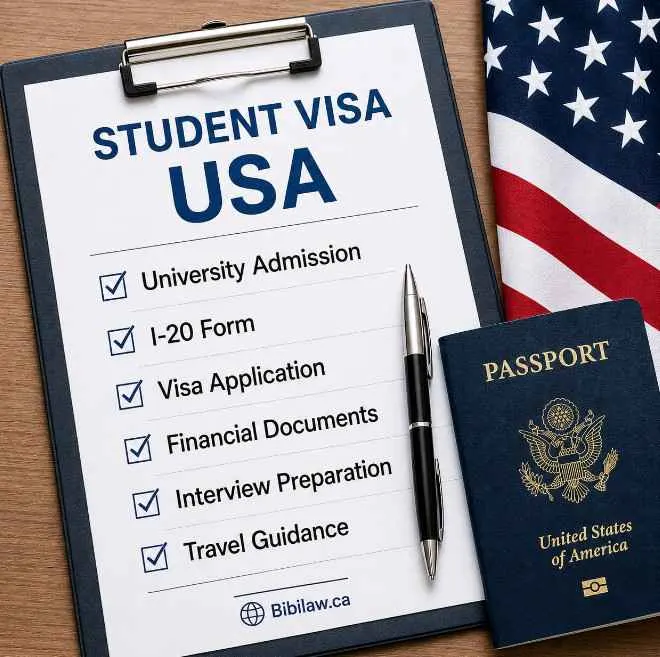
Getting the visa is only the beginning. After arriving in the United States, students must maintain their status. This usually means attending the school listed on the I-20, enrolling full-time unless authorized otherwise, keeping passport and documents valid, updating address information when required, avoiding unauthorized employment, and speaking with the school’s Designated School Official before making major changes.
If you want to transfer schools, reduce course load, take a break, extend your program, travel outside the U.S., apply for practical training, or change status, you should get proper guidance before acting. Student status can be affected by decisions that may seem small at the time.
How Bibi Law Can Help
The Student Visa USA process can feel stressful because it combines admission, immigration rules, financial documents, personal history, and interview preparation. Bibi Law helps students and families understand the process, organize their documents, identify possible weaknesses, and prepare a clearer application strategy.
For students in Canada, cross-border planning can be especially important. Your Canadian status, education history, family situation, financial sponsorship, and future goals may all need to be presented properly. Bibi Law can help you review your situation, prepare questions, organize your file, and understand the next steps before you move forward.
A well-prepared application does not guarantee approval, but it can reduce confusion and improve the quality of your presentation. When your documents, answers, and study plan work together, your application becomes stronger and easier to understand.
FAQs About Student Visa USA
1. What is the most common Student Visa USA category?
The most common category is the F-1 visa, which is used for academic study at approved U.S. schools, colleges, universities, language programs, and other academic institutions.
2. What is the difference between F-1 and M-1 visas?
The F-1 visa is generally for academic study, while the M-1 visa is for vocational or non-academic study. Your school and program type determine which category applies.
3. Do I need Form I-20 for a U.S. student visa?
Yes. The Form I-20 is required for F-1 and M-1 student visa applications. It is issued by your approved U.S. school after acceptance and SEVIS registration.
4. Can I enter the USA on a visitor visa and study?
You generally cannot enter on a visitor visa to complete a degree, certificate, or academic program. Short recreational study may be allowed in limited cases, but formal study usually requires proper student status.
5. How early can I apply for a USA student visa?
New F and M student visas may be issued up to 365 days before the program start date, but new students are generally not allowed to enter the United States more than 30 days before the program start date.
6. What documents are needed for a Student Visa USA interview?
Common documents include passport, DS-160 confirmation, appointment confirmation, visa fee receipt, SEVIS fee receipt, Form I-20, admission letter, academic records, financial proof, sponsor documents, and any required test scores.
7. Can I work while studying in the USA?
Some F-1 students may be eligible for limited authorized work, such as on-campus employment or practical training. Unauthorized work can create serious immigration problems, so students should confirm eligibility before working.
8. Can my spouse and children come with me?
Your spouse and unmarried minor children may be eligible for dependent status, such as F-2 or M-2. They will need their own documents, including individual Form I-20s from the school.
9. What happens if my student visa is refused?
A refusal does not always mean you can never apply again. You may reapply if your circumstances change or you can provide stronger evidence. It is important to understand the refusal reason before submitting a new application.
10. Can Bibi Law help with Student Visa USA guidance?
Yes. Bibi Law can help students and families understand the process, organize documents, review potential weaknesses, and prepare a stronger study plan and interview strategy.
Studying in the United States can be one of the most rewarding decisions of your life, but the visa process deserves serious attention. The right school, correct visa category, accurate Form I-20, strong financial proof, honest DS-160, clear interview answers, and proper timing all matter.
The best approach is simple: plan early, stay honest, prepare carefully, and get guidance when needed. A Student Visa USA application is not just paperwork. It is your story, your purpose, your education plan, and your future presented in a structured way.
If you are planning to study in America from Canada or need help understanding your options, visit bibilaw.ca and connect with Bibi Law for professional guidance.