
Employment-Based Visa USA: A Powerful Pathway for Skilled Workers, Professionals, Investors, and Global Talent
For many ambitious professionals, the dream of building a future in the United States does not begin with luck. It begins with skill, planning, documentation, and the right immigration pathway. The Employment-Based Visa USA process is one of the most important routes for foreign nationals who want to work, grow, invest, or settle permanently in the United States through their professional abilities. Whether you are a Canadian resident exploring U.S. career opportunities, an international worker with specialized experience, a business owner planning expansion, or a family hoping for long-term stability, employment-based immigration can open doors that temporary visas often cannot. At Bibi Law, we understand that behind every application is a real person, a real career, and a real future. The process can feel overwhelming, but with the right guidance, it becomes easier to understand which category fits your profile, what documents are required, and how to avoid mistakes that can delay or weaken your case.
What Is an Employment-Based Visa USA?
An Employment-Based Visa USA is an immigration pathway that allows eligible foreign nationals to work in the United States based on their employment, professional qualifications, investment, extraordinary ability, or job offer. In many cases, employment-based visas can also lead to lawful permanent residence, commonly known as a green card. This makes the process especially attractive for people who want more than short-term work permission. They want a stable future, long-term career growth, and the ability to live in the United States with qualifying family members.
Employment-based immigration is not a single visa. It is a system made up of different categories, each designed for a specific type of applicant. Some categories require a U.S. employer to sponsor the worker. Others may allow self-petitioning if the applicant meets strong eligibility standards. Some pathways focus on exceptional talent, while others are built for professionals, skilled workers, religious workers, special immigrants, or investors. Choosing the wrong category can waste time and money, which is why proper assessment is one of the most important first steps.
Why Employment-Based Immigration Matters for Canadians and International Applicants in Canada
Many people living in Canada look toward the United States for career growth, business expansion, medical research, technology opportunities, academic roles, investment projects, and executive positions. Because Canada and the United States have strong economic ties, cross-border employment and business movement are common. However, working in the United States is not as simple as receiving a job offer and crossing the border. U.S. immigration rules require the correct visa classification, proper petitioning, and strong supporting evidence.
For applicants in Canada, the Employment-Based Visa USA process can be especially important if they are already building international careers. A software engineer in Toronto, a healthcare professional in Vancouver, a business owner in Calgary, or a researcher in Montréal may all have different immigration options depending on their background. The key is not just asking, “Can I work in the United States?” The better question is, “Which employment-based pathway gives me the strongest chance based on my profile?”
Main Employment-Based Visa USA Categories
The U.S. employment-based immigrant visa system is generally divided into five preference categories: EB-1, EB-2, EB-3, EB-4, and EB-5. Each category has different requirements, processing steps, and evidence expectations. Understanding these categories helps applicants avoid confusion and focus on the route that best matches their qualifications.
EB-1 is commonly used for priority workers, including individuals with extraordinary ability, outstanding professors or researchers, and certain multinational executives or managers. This category is often attractive because some applicants may not need the traditional labor certification process. However, the evidence standard can be high, and applicants must show strong achievements, recognition, leadership, or major contributions.
EB-2 is generally for professionals with advanced degrees or individuals with exceptional ability. It may also include the National Interest Waiver, often called NIW, where eligible applicants may request that the job offer and labor certification requirements be waived because their proposed work benefits the United States. This category is popular among researchers, entrepreneurs, engineers, healthcare professionals, and highly qualified experts.
EB-3 is generally for skilled workers, professionals, and certain other workers. This category often requires a permanent job offer from a U.S. employer and labor certification through the Department of Labor. Many employer-sponsored green card cases fall under EB-3, especially when the worker has the education, training, or experience required for the offered position.
EB-4 is for certain special immigrants. This may include specific religious workers and other defined special immigrant groups. The eligibility rules are more specialized, so applicants must carefully confirm whether they fit one of the recognized subcategories.
EB-5 is for immigrant investors who make a qualifying investment in a U.S. business and meet job creation requirements. This category is designed for investors who can place capital at risk and contribute to the U.S. economy through employment creation. Because EB-5 involves investment funds, business documentation, source of funds evidence, and strict compliance requirements, legal guidance is highly important.
Employer Sponsorship and the Role of a U.S. Job Offer
For many employment-based visa cases, a U.S. employer plays a central role. The employer may need to offer a permanent full-time position, complete recruitment steps, file required forms, and prove the ability to pay the offered wage. This is why employment-based immigration is often a partnership between the applicant and the sponsoring employer. The applicant must prove qualifications, while the employer must prove the job opportunity is real and meets U.S. immigration standards.
A strong job offer is not just a letter. It must match the visa category, the applicant’s background, and the employer’s business needs. If the job description is too vague, inconsistent, or not properly aligned with the applicant’s qualifications, the petition may face problems. Careful preparation can help ensure that the job duties, education requirements, experience requirements, wage level, and evidence are presented clearly.
What Is PERM Labor Certification?
PERM labor certification is a common step in many EB-2 and EB-3 employer-sponsored green card cases. In simple words, PERM is a process where the U.S. employer must show that there are not sufficient qualified, willing, and available U.S. workers for the position and that hiring the foreign worker will not negatively affect wages and working conditions for U.S. workers in similar roles.
This step is often one of the most technical parts of the Employment-Based Visa USA process. It may involve a prevailing wage determination, recruitment, advertising, careful recordkeeping, and filing with the U.S. Department of Labor. Errors in recruitment timelines, job requirements, wage issues, or documentation can cause delays or denials. Because of this, applicants and employers should treat PERM as a serious compliance process rather than a simple formality.
Form I-140 and the Immigrant Petition Stage
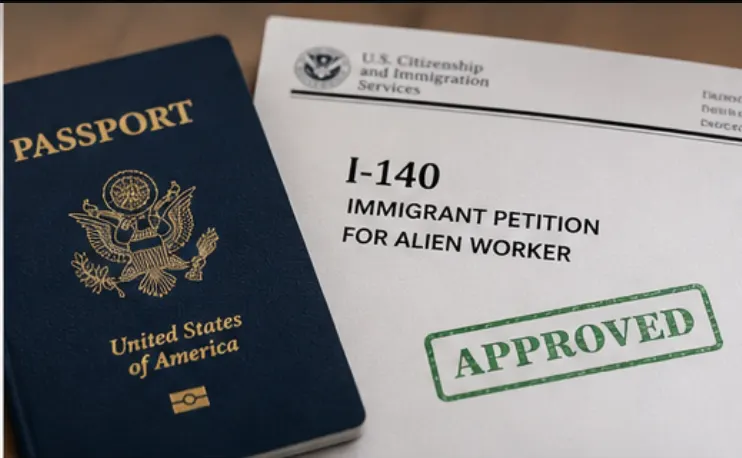
After the appropriate early steps are complete, many employment-based immigrant cases move to Form I-140, Immigrant Petition for Alien Worker. This petition is filed with USCIS to classify the worker under the correct employment-based category. The petition must include evidence that the applicant qualifies and, when required, that the employer meets the ability-to-pay requirement.
An approved I-140 is an important milestone, but applicants should understand what it does and does not do. Approval of the petition does not automatically mean the applicant has a green card. It confirms that the applicant qualifies under a specific employment-based category, but the applicant may still need to wait for visa availability and complete adjustment of status in the United States or consular processing outside the United States.
Visa Bulletin, Priority Dates, and Waiting Times
One of the most confusing parts of employment-based immigration is the Visa Bulletin. Because employment-based immigrant visas are numerically limited, applicants may need to wait until their priority date becomes current. A priority date is usually the applicant’s place in line. For cases that require PERM, the priority date is often tied to the labor certification filing date. For some cases that do not require PERM, it may be tied to the immigrant petition filing date.
Waiting times can vary widely depending on the visa category and the applicant’s country of chargeability. Some categories move faster, while others may experience backlogs. This is why timing strategy matters. Filing early, choosing the right category, preserving priority dates where possible, and monitoring visa availability can make a major difference in long-term planning.
Adjustment of Status or Consular Processing
Once an employment-based immigrant visa is available, the applicant usually moves toward one of two final paths: adjustment of status or consular processing. Adjustment of status may be available to applicants who are already in the United States and meet the requirements to apply for permanent residence from inside the country. Consular processing is usually used when the applicant is outside the United States and completes the immigrant visa process through a U.S. embassy or consulate.
For applicants in Canada, consular processing may be relevant if they are not physically present in the United States. However, the best route depends on the person’s immigration history, current location, visa availability, family situation, and overall strategy. Choosing the correct final step is important because mistakes can lead to delays, extra costs, or complications.
Can Family Members Be Included?
One major benefit of Employment-Based Visa USA cases is that qualifying family members may often be included as derivatives. This usually means a spouse and unmarried children under 21 may be able to apply with the principal applicant. For families planning a move from Canada or another country to the United States, this can be one of the most important parts of the process.
Family documentation must be accurate and complete. Marriage certificates, birth certificates, passports, civil records, translations, and other supporting documents may be required. If a child is close to turning 21, timing can become especially sensitive. Families should seek guidance early to avoid problems related to age-out issues, missing documents, or inconsistent personal history.
Common Mistakes in Employment-Based Visa USA Applications
Many Employment-Based Visa USA problems happen not because the applicant is unqualified, but because the case is poorly prepared. Common mistakes include choosing the wrong visa category, submitting weak evidence, using inconsistent job descriptions, misunderstanding PERM requirements, ignoring priority date issues, failing to prove the employer’s ability to pay, or assuming that a job offer alone is enough.
Another frequent mistake is waiting too long to begin planning. Employment-based immigration can take time, especially when labor certification or visa backlogs are involved. Applicants who start early can build stronger evidence, correct weak areas, coordinate better with employers, and avoid last-minute pressure.
Documents Often Needed for Employment-Based Immigration
The documents required will depend on the category, but many cases require a combination of personal, professional, employer, and immigration records. Applicants may need passports, resumes, academic degrees, transcripts, employment letters, pay records, professional licenses, awards, publications, reference letters, proof of achievements, business records, and prior immigration documents. Employers may need financial records, tax documents, payroll evidence, company information, job descriptions, recruitment records, and proof of business operations.
Document quality matters. Immigration officers review evidence carefully. A strong case usually tells a clear story: who the applicant is, what the employer needs, why the applicant qualifies, and how the case fits the legal category. When documents are incomplete, inconsistent, or poorly organized, even a strong applicant may face unnecessary challenges.
Why Legal Guidance Matters
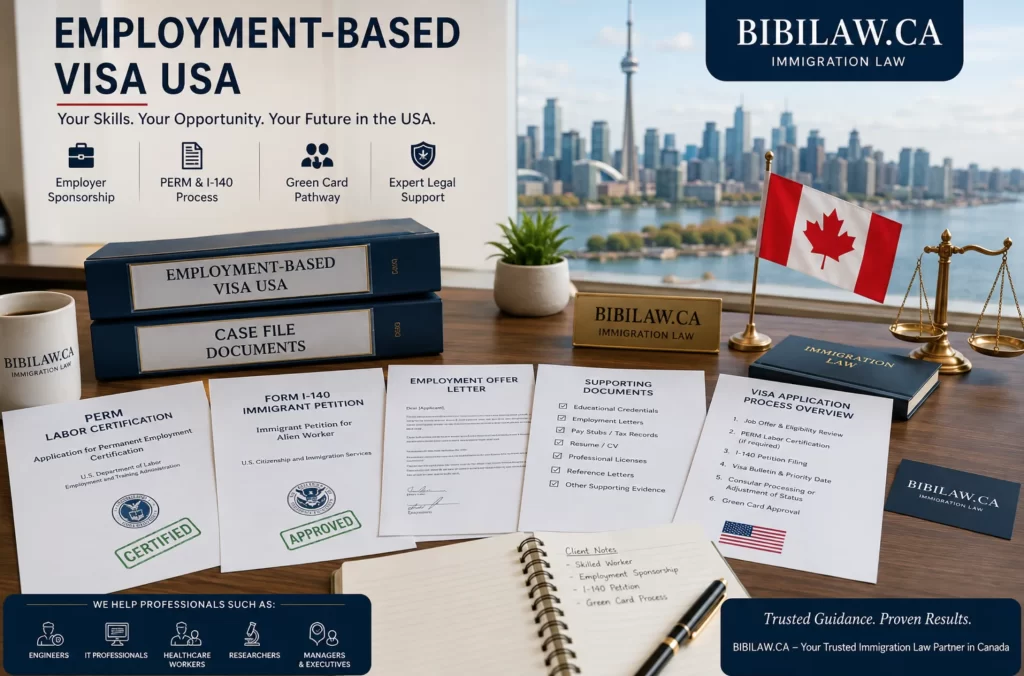
The Employment-Based Visa USA process is not just paperwork. It is a legal strategy. Every case has moving parts: category selection, eligibility analysis, employer coordination, evidence preparation, timing, family planning, visa availability, and government processing. A small mistake at the beginning can create bigger problems later.
Bibi Law helps clients understand immigration options with clarity and confidence. For applicants in Canada exploring U.S. employment-based immigration, professional guidance can help identify the right pathway, prepare stronger documentation, and reduce avoidable risks. Whether your case involves a job offer, advanced degree, professional skill, executive transfer background, extraordinary ability, or investment planning, the right strategy can make the process more manageable.
Who Should Consider an Employment-Based Visa USA?
You may want to explore an Employment-Based Visa USA if you have a U.S. job offer, advanced degree, specialized experience, strong professional achievements, business investment capacity, executive or managerial experience, research background, or a career profile that may benefit the United States. Employers may also consider this pathway when they need to retain valuable foreign talent for long-term roles.
This process is especially useful for applicants who want permanent opportunities rather than temporary work arrangements. Temporary visas can be helpful, but they may come with limits, renewals, employer restrictions, and uncertainty. Employment-based immigrant visas can offer a more stable long-term solution when the applicant qualifies.
Frequently Asked Questions About Employment-Based Visa USA
1. What is an Employment-Based Visa USA?
An Employment-Based Visa USA is a U.S. immigration pathway for foreign nationals who qualify through employment, professional skills, investment, extraordinary ability, or employer sponsorship. Some employment-based categories can lead to permanent residence, also known as a green card.
2. Do I need a U.S. job offer for an employment-based visa?
Many Employment-Based Visa USA categories require a U.S. job offer and employer sponsorship, especially EB-2 and EB-3 cases involving PERM labor certification. However, some categories, such as certain EB-1 cases or EB-2 National Interest Waiver cases, may allow eligible applicants to self-petition.
3. What is the difference between EB-1, EB-2, and EB-3?
EB-1 is generally for priority workers such as extraordinary ability applicants, outstanding professors or researchers, and multinational executives or managers. EB-2 is generally for advanced degree professionals or people with exceptional ability. EB-3 is generally for skilled workers, professionals, and certain other workers.
4. What is PERM in employment-based immigration?
PERM is a labor certification process handled through the U.S. Department of Labor. It is often required in employer-sponsored EB-2 and EB-3 cases. The employer must show that hiring the foreign worker meets labor market and wage requirements.
5. Can Canadians apply for an Employment-Based Visa USA?
Yes, Canadian citizens and residents may be able to apply if they meet the requirements of a specific Employment-Based Visa USA category. The right pathway depends on the applicant’s qualifications, job offer, employer, investment plans, or professional achievements.
6. Can my family come with me?
In many Employment-Based Visa USA cases, a spouse and unmarried children under 21 may be eligible to apply as derivative family members. Family eligibility depends on the principal applicant’s case and the stage of the process.
7. Does an approved I-140 mean I have a green card?
No. An approved I-140 is an important step, but it does not automatically grant permanent residence. The applicant must still complete the next stage, such as adjustment of status or consular processing, when eligible.
8. How long does the Employment-Based Visa USA process take?
Processing time depends on the visa category, whether PERM is required, government processing times, visa availability, priority dates, country of chargeability, and the strength of the case. Some cases move faster than others, while backlogged categories may take longer.
9. Is EB-5 only for wealthy investors?
EB-5 is designed for qualifying immigrant investors who can meet specific investment and job creation requirements. Because it involves strict financial documentation and compliance rules, applicants should get professional guidance before moving forward.
10. How can Bibi Law help?
Bibi Law can help applicants understand their options, review eligibility, organize documentation, and plan the next steps for an Employment-Based Visa USA strategy. Because every case is different, a personalized assessment is the best way to begin.
Your Career Deserves a Strong Immigration Strategy
An Employment-Based Visa USA can be a life-changing opportunity, but it requires more than ambition. It requires planning, evidence, timing, and legal understanding. The best cases are built carefully, with every document supporting the larger story of eligibility and future contribution. Whether you are a professional in Canada, an employer looking to sponsor talent, an investor exploring U.S. opportunities, or a skilled worker planning your next chapter, the right guidance can help you move forward with confidence.
At Bibi Law, we believe immigration decisions should never be rushed or guessed. Your career, your family, and your future deserve a clear strategy. If you are considering an Employment-Based Visa USA, now is the right time to review your options, understand your category, and prepare your case properly.