
Family-Based Immigration USA: Bringing Loved Ones Closer Through the Right Legal Path
Family is often the strongest reason people choose to immigrate. A spouse waiting in another country, a parent hoping to reunite with children, or a citizen wanting to sponsor a brother or sister — these are not just immigration files. They are real lives, real relationships, and real futures. Family-Based Immigration USA is one of the most important pathways for people who want to live permanently in the United States through a qualifying family relationship. But while the idea sounds simple, the process can become stressful when forms, proof, timelines, visa categories, interviews, financial requirements, and government rules start to overlap.
For many families in Canada, the United States, South Asia, the Middle East, Africa, and other regions, the biggest challenge is not only knowing whether they qualify. The bigger challenge is understanding which category applies, what documents are needed, how long the process may take, and what mistakes can delay or damage a case. A missing birth certificate, weak marriage evidence, incorrect form, outdated civil document, or misunderstanding of priority dates can turn a hopeful family plan into months or years of frustration. That is why proper guidance matters from the beginning.
At Bibi Law Canada, we understand that family immigration is emotional, time-sensitive, and deeply personal. Whether someone is exploring a U.S. spousal petition, parent sponsorship, child sponsorship, or family preference category, the first step is clarity. This guide explains the major parts of Family-Based Immigration USA in simple language so families can understand the process before making important decisions.
What Is Family-Based Immigration USA?
Family-Based Immigration USA is a legal pathway that allows certain U.S. citizens and lawful permanent residents, also known as Green Card holders, to sponsor eligible family members for permanent residence in the United States. The sponsored person may be living outside the United States or, in some cases, already inside the United States. The goal of the process is to prove that a qualifying family relationship exists and that the applicant meets the legal requirements for immigrant visa or Green Card approval.
This pathway is built around family reunification. The United States immigration system recognizes that close family relationships should have a route to permanent residence. However, not every relative qualifies, and not every family category moves at the same speed. Some close relatives of U.S. citizens may have faster options because there is no annual numerical cap on those visa categories. Other relatives fall under family preference categories, where annual limits apply and waiting times may depend on the applicant’s category and country of chargeability.
Many families make the mistake of thinking that any U.S. family connection is enough. In reality, eligibility depends on the sponsor’s status, the applicant’s relationship to the sponsor, age, marital status, immigration history, admissibility, financial support documents, and whether the applicant will complete the process through consular processing or adjustment of status. This is why it is important to analyze the full case before filing.
Who Can Sponsor a Family Member for U.S. Immigration?
A U.S. citizen may be able to sponsor a spouse, unmarried child under 21, parent, unmarried adult son or daughter, married son or daughter, and sibling, depending on the category. A lawful permanent resident may generally sponsor a spouse and unmarried children. The sponsor must usually file a family petition to establish the relationship and show that the sponsored family member fits within a recognized immigration category.
The sponsor’s immigration status makes a major difference. For example, the spouse of a U.S. citizen is usually treated differently from the spouse of a Green Card holder. A parent of a U.S. citizen may qualify as an immediate relative if the U.S. citizen child is at least 21 years old. A sibling petition may be possible for a U.S. citizen, but not usually for a lawful permanent resident. These details matter because they affect the filing strategy, expected timeline, and visa availability.
The sponsor also has a financial responsibility. In most family-based cases, the U.S. sponsor must show the ability to financially support the intending immigrant by submitting an affidavit of support. This is designed to prove that the applicant is not likely to become dependent on public assistance. If the sponsor’s income is not enough, a qualified joint sponsor may sometimes be needed. Financial evidence should be prepared carefully because weak or incomplete support documents can delay the case.
Immediate Relative Categories in Family-Based Immigration USA
Immediate relative categories are among the most important parts of Family-Based Immigration USA because they apply to close relatives of U.S. citizens. These may include spouses of U.S. citizens, unmarried children under 21 of U.S. citizens, and parents of U.S. citizens when the citizen is at least 21. These categories are often preferred because there is generally no annual numerical limit on immigrant visas for immediate relatives.
This does not mean approval is automatic. The applicant must still prove the family relationship, satisfy admissibility requirements, complete medical and background checks, submit accurate forms, and attend interviews when required. In marriage-based cases, the couple must prove the marriage is genuine and not entered into only for immigration benefits. Evidence may include joint financial documents, photos, communication history, travel records, family records, lease documents, insurance records, children’s birth certificates, and other proof showing a real shared life.
Immediate relative cases can still become complicated if there are prior refusals, overstays, removal orders, criminal issues, misrepresentation concerns, missing documents, name discrepancies, previous marriages, or insufficient relationship evidence. Families should never assume that a “close relationship” alone is enough. The petition must be well-documented from the start.
Family Preference Categories: F1, F2A, F2B, F3, and F4
Family preference categories are for certain family members of U.S. citizens and lawful permanent residents who are not classified as immediate relatives. These categories are subject to annual visa limits, which means applicants may need to wait until an immigrant visa becomes available. The waiting period depends on the category and the applicant’s country.
The F1 category generally covers unmarried adult sons and daughters of U.S. citizens. The F2A category includes spouses and unmarried children under 21 of lawful permanent residents. The F2B category includes unmarried adult sons and daughters of lawful permanent residents. The F3 category covers married sons and daughters of U.S. citizens. The F4 category is for brothers and sisters of U.S. citizens, where the sponsoring U.S. citizen is at least 21 years old.
These categories can be confusing because a person’s age or marital status can change the entire case. For example, if an unmarried adult child gets married, the category may change. If a lawful permanent resident sponsor becomes a U.S. citizen, the case may sometimes move into a different category. If a child ages out, special rules may need to be considered. These are not small technical points; they can affect years of waiting time. A careful review helps families avoid avoidable damage.
Form I-130: The Foundation of Most Family-Based Cases
In most family-based immigration cases, the process begins with Form I-130, Petition for Alien Relative. This form is used by the U.S. citizen or lawful permanent resident sponsor to prove the qualifying family relationship. Filing the petition is not the same as receiving a Green Card. It is the first major step to establish eligibility for the family category.
The evidence required depends on the relationship. A spouse petition may require a marriage certificate, proof of termination of prior marriages, identity documents, photos, communication records, joint documents, and proof of a genuine relationship. A parent-child case may require birth certificates, adoption records where applicable, and evidence connecting the sponsor and beneficiary. A sibling case may require documents proving the shared parent relationship.
One of the biggest mistakes families make is treating Form I-130 like a basic formality. It is not. A weak petition can lead to requests for evidence, delays, interviews, or even denial. Every answer should match the supporting documents. Names, dates, addresses, previous immigration history, and family details should be consistent. If there are differences in spelling, missing records, delayed birth registration, or cultural naming variations, they should be addressed properly.
Consular Processing vs. Adjustment of Status
After a family petition is approved and a visa is available, the applicant may move forward through either consular processing or adjustment of status, depending on where they are and whether they qualify. Consular processing usually applies when the applicant is outside the United States. The case moves through the National Visa Center and then to a U.S. embassy or consulate for interview and visa processing.
Adjustment of status may apply when the applicant is already inside the United States and meets the legal requirements to apply for permanent residence without leaving the country. This process usually involves filing Form I-485, along with required supporting documents. However, eligibility for adjustment of status can be complex, especially if the applicant has immigration violations, unauthorized employment, unlawful presence, or other issues.
Choosing the correct path is very important. Some applicants should not leave the United States without legal advice because departure may trigger bars to re-entry. Others may not qualify to adjust status and may need consular processing. Families should not guess. The wrong decision can create serious immigration consequences.
Documents Commonly Needed for Family-Based Immigration USA
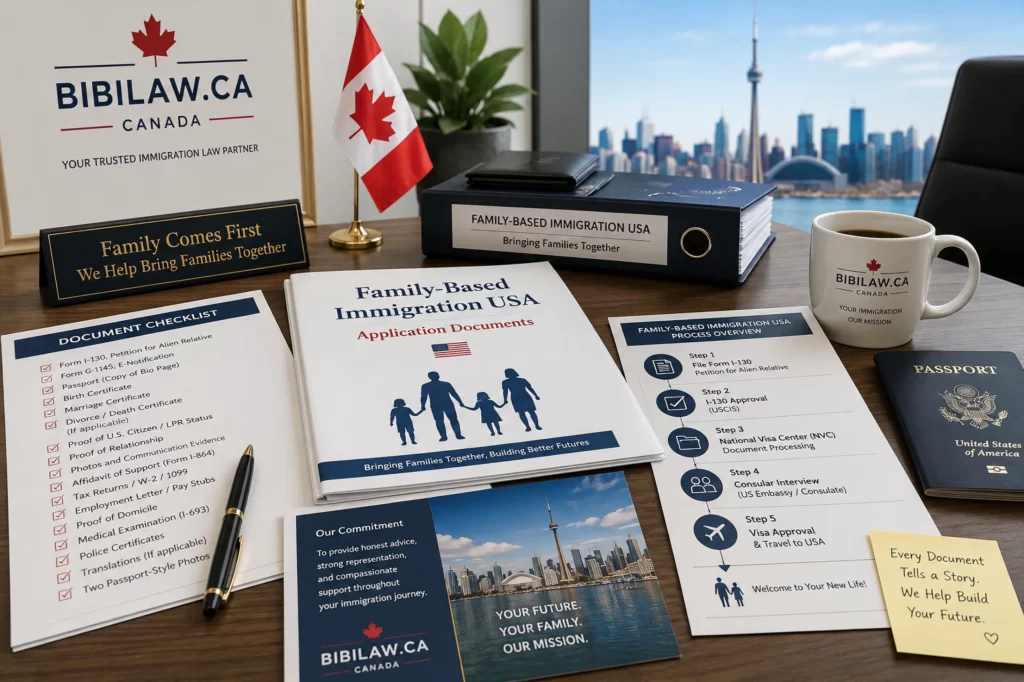
The documents required in Family-Based Immigration USA depend on the category, country of birth, country of residence, relationship type, and processing route. However, many cases require identity documents, passports, birth certificates, marriage certificates, divorce certificates, death certificates for prior spouses where applicable, police certificates for consular processing, medical examination records, financial sponsorship documents, tax records, proof of domicile, and relationship evidence.
For marriage-based cases, relationship proof is especially important. Officers may review whether the couple has combined finances, shared residence, consistent communication, family involvement, travel history, cultural wedding traditions, photographs over time, and long-term plans. A beautiful wedding album alone may not be enough if the rest of the evidence is weak. The goal is to show a real marriage with genuine commitment.
For parent, child, and sibling cases, civil documents must clearly prove the legal relationship. In some countries, birth records may be delayed, incomplete, or inconsistent. If documents are unavailable, alternative evidence may be needed. Every case should be prepared based on the applicant’s specific facts, not copied from someone else’s file.
Common Reasons Family-Based Immigration Cases Get Delayed
Family immigration cases often get delayed because of incomplete forms, missing documents, incorrect fees, outdated forms, weak relationship evidence, inconsistent dates, unclear translations, financial sponsorship problems, or slow response to government requests. Delays can also happen when visa numbers are not available in preference categories or when embassy interview backlogs affect consular processing.
Another common issue is poor communication between family members. The sponsor may live in the United States, the applicant may live abroad, and documents may be spread across different countries. If nobody is organizing the file properly, important records can be missed. A case that should be straightforward can become complicated simply because the preparation was rushed.
Applicants should also be careful about past immigration history. Prior U.S. visa refusals, overstays, unlawful presence, unauthorized work, removal proceedings, criminal charges, or alleged misrepresentation can create serious problems. These issues should be reviewed before filing, not after receiving a refusal or request for evidence.
Why Canadian Families Often Search for U.S. Family Immigration Help
Many families in Canada have close relatives in the United States. Some Canadian permanent residents or citizens have spouses, parents, children, siblings, or extended family members living in America. Others may have moved between Canada and the U.S. for work, study, marriage, business, or family reasons. Because the two countries are closely connected, cross-border family immigration questions are common.
A person in Canada may want to join a U.S. citizen spouse. A U.S. citizen living in Canada may want to sponsor a spouse or child. A Green Card holder may need help understanding whether they can sponsor a family member while managing residence obligations. A family may need to understand whether the process will happen through a U.S. consulate, what documents are required from Canada, and how to prepare for interview questions.
This is where clear legal information becomes valuable. Families should understand the U.S. process, but they should also think about Canadian residence, travel history, tax documents, employment records, and long-term settlement plans. Cross-border planning is not only about forms. It is about protecting the family’s future.
How Bibi Law Canada Can Help Families Understand Their Options
At Bibi Law Canada, the focus is on helping families approach immigration decisions with clarity, preparation, and confidence. Family-based immigration can feel overwhelming because every category has different rules, and every family has a different story. A strong case begins with understanding the relationship, the sponsor’s status, the applicant’s background, the correct category, the right process, and the risks that may need attention.
Families often come with urgent questions: Can I sponsor my spouse? Can a Green Card holder sponsor a child? How long will a sibling petition take? What happens if my child turns 21? Can I apply from Canada? What if I had a U.S. visa refusal before? What if my marriage is recent? What if my documents have spelling mistakes? These questions deserve careful answers, not guesswork.
Before submitting any family immigration application, it is wise to review eligibility, evidence, financial requirements, timelines, and possible complications. A well-prepared file can reduce confusion and help the family move forward with a stronger understanding of the process.
Best Practices Before Filing a Family-Based Immigration Case
The first best practice is to confirm the correct category before filing. A sponsor should know whether the applicant is an immediate relative or family preference immigrant. This affects visa availability, timeline, and strategy. The second best practice is to collect documents early. Civil documents, translations, police certificates, financial records, and relationship evidence can take time to prepare.
The third best practice is to be honest about immigration history. If there was a past refusal, overstay, removal, misrepresentation issue, criminal matter, or unlawful presence concern, it should be reviewed carefully. Hiding a problem usually makes it worse. The fourth best practice is to keep copies of everything submitted. Families should maintain organized digital and physical records of forms, receipts, notices, civil documents, and correspondence.
The fifth best practice is to avoid relying only on online stories. Immigration forums and social media can be helpful for general awareness, but every case depends on facts. What worked for one family may not work for another. A case involving a Canadian applicant may be different from a case involving an applicant from India, Pakistan, the UAE, Nigeria, the Philippines, or another country. Personal history matters.
FAQ: Family-Based Immigration USA
1. What is Family-Based Immigration USA?
Family-Based Immigration USA is a pathway that allows eligible U.S. citizens and lawful permanent residents to sponsor certain family members for permanent residence in the United States. The process depends on the sponsor’s status, the family relationship, visa category, and the applicant’s background.
2. Who can a U.S. citizen sponsor?
A U.S. citizen may be able to sponsor a spouse, unmarried child under 21, parent, unmarried adult child, married child, and sibling. Some categories are faster than others, and siblings or adult children may face longer waits due to annual visa limits.
3. Can a Green Card holder sponsor family members?
Yes, a lawful permanent resident may generally sponsor a spouse and unmarried children. Green Card holders cannot usually sponsor parents, married children, or siblings unless they become U.S. citizens and meet the relevant requirements.
4. Is a spouse of a U.S. citizen an immediate relative?
Yes, a spouse of a U.S. citizen is usually considered an immediate relative for immigration purposes. However, the marriage must be legally valid and genuine, and the couple must provide strong evidence of a real relationship.
5. What is Form I-130?
Form I-130, Petition for Alien Relative, is usually the first major form in a family-based immigration case. It is filed by the U.S. citizen or Green Card holder sponsor to prove the qualifying family relationship.
6. How long does Family-Based Immigration USA take?
The timeline depends on the category, country, government processing times, visa availability, document readiness, and whether the applicant is using consular processing or adjustment of status. Immediate relative cases may move faster than family preference cases, but every case is different.
7. What is the Visa Bulletin?
The Visa Bulletin is used to show visa availability for preference categories. Family preference applicants often need to monitor priority dates to know when their case can move forward.
8. Can a family member apply from Canada?
Yes, many applicants living in Canada may complete parts of the U.S. family immigration process from Canada, often through consular processing if they are outside the United States. The correct route depends on the applicant’s facts and eligibility.
9. What documents are needed for a family-based immigration case?
Common documents include passports, birth certificates, marriage certificates, divorce records, financial sponsorship documents, tax records, relationship evidence, police certificates, translations, and medical examination records. The exact list depends on the case type.
10. Can a case be denied?
Yes. A family-based immigration case can be denied because of ineligibility, weak evidence, inconsistent information, financial sponsorship issues, inadmissibility, fraud concerns, missing documents, or failure to respond properly to government requests.
11. Do I need legal guidance for Family-Based Immigration USA?
Legal guidance is strongly recommended when there are complex facts, past refusals, immigration violations, criminal history, unclear documents, financial sponsorship issues, or uncertainty about the correct category. Even straightforward cases benefit from careful preparation.
12. How can Bibi Law Canada help?
Bibi Law Canada can help families understand the process, organize key information, identify possible concerns, and prepare for informed next steps. Family immigration decisions should be made with clarity, especially when loved ones and long-term plans are involved.
Family Immigration Is a Journey, Not Just a Form
Family-Based Immigration USA is one of the most meaningful immigration pathways because it is built around reunification. Behind every petition is a family hoping to live together, support each other, and build a stable future. But the process requires patience, accuracy, evidence, and legal awareness. A strong family relationship must still be proven in the way immigration authorities expect.
Whether the case involves a spouse, parent, child, adult son or daughter, or sibling, families should take the process seriously from the first step. Filing quickly is not always the same as filing correctly. Careful preparation can make a major difference in avoiding delays, confusion, and unnecessary stress.
For families in Canada and abroad exploring U.S. family sponsorship, Bibi Law Canada offers guidance-focused support to help you understand your options and prepare for the next step with confidence. When your family’s future is involved, clarity is not optional — it is essential.