
What Nobody Tells You Before You Apply
There is a moment that almost every immigrant in the United States knows by heart. You finally have your green card. You have your job, your apartment, your routine. Life is stable. And then you pick up the phone, call your mother, your brother, your spouse still waiting back home, and you realize that the hardest part of building a life in America was never the work visa or the paperwork. It was leaving the people who matter most on the other side of an ocean. Family Sponsorship USA
Family sponsorship in the USA exists precisely because of that reality. It is the legal pathway that allows U.S. citizens and lawful permanent residents to petition for their loved ones to immigrate to the United States and eventually receive a green card — the right to live, work, and build a future here permanently. But here is what most people do not tell you upfront: this process is significantly more complex, more emotionally draining, and more time-consuming than any government brochure makes it appear.
This guide is going to walk you through everything — honestly. Who can sponsor whom, what the actual timelines look like, what the financial obligations are, what mistakes kill applications, and how having experienced legal support at your side can be the single most important decision you make. If you are thinking about sponsoring a family member to come to the United States, read every word of this.
What Is Family Sponsorship and Why Does It Matter?
Family-based immigration is one of the two primary pathways to permanent residency in the United States — the other being employment-based immigration. Through family sponsorship, a U.S. citizen or green card holder (called the petitioner or sponsor) files a petition on behalf of a foreign national relative (called the beneficiary) to allow that person to immigrate and eventually receive a green card.
This is not a small program. Year after year, family-sponsored immigrants make up the largest share of legal permanent residents admitted to the United States. The entire framework is built on a foundational belief that families should not be permanently separated by borders. Yet the irony is that the system that was built to unite families is also one of the most backlogged, bureaucratically complex immigration processes in the world. Understanding why — and how to navigate it — is the first step to doing this right.
Who Can Be Sponsored? Understanding the Two Categories
The U.S. immigration system divides family-based sponsorship into two major categories: Immediate Relatives and Family Preference Categories. The distinction is enormous, not just in terms of who qualifies but in how long the process takes and how many visas are available each year.
Immediate Relatives of U.S. Citizens
This is the most favorable category in the entire family immigration system, and for good reason. Immediate relatives of U.S. citizens are not subject to annual numerical caps. That means there is no waiting list, no priority date to wait on, and no annual quota cutting off the line. The only limiting factor is completing the process itself.
Who qualifies as an immediate relative? A spouse of a U.S. citizen qualifies, as does an unmarried child under 21 years of age of a U.S. citizen, and a parent of a U.S. citizen — provided that the citizen sponsoring the parent is at least 21 years old. If you are a U.S. citizen and your spouse is still abroad, or your elderly parent wants to join you in America, or your child is under 21 and unmarried, this is your pathway. It is still a process, but it is the fastest lane available in family immigration.
Family Preference Categories
Every other family relationship falls into what are called the family preference categories. These categories do have annual numerical caps, and because demand far exceeds the available visa numbers every single year, beneficiaries can wait for years — sometimes decades — before a visa becomes available to them.
The four preference categories are structured as follows. The first preference category covers unmarried sons and daughters of U.S. citizens who are 21 years of age or older. The second preference category is split into two parts: the first part covers spouses and unmarried children under 21 of lawful permanent residents, and the second part covers unmarried sons and daughters who are 21 or older of lawful permanent residents. The third preference category covers married sons and daughters of U.S. citizens, regardless of age. The fourth preference category covers brothers and sisters of U.S. citizens, again provided the sponsoring citizen is at least 21.
The wait times in the preference categories can be staggering. For some categories and some nationalities — particularly those from countries like India, Mexico, China, and the Philippines — the backlog is so severe that applicants may wait 10, 15, or even 20 or more years before their visa number becomes current. This is not a typo or an exaggeration. This is the lived reality of thousands of families waiting in the queue.
The Sponsoring Party: Who Can File a Petition?
Before diving into the process itself, it is worth being very clear about who is eligible to sponsor a family member in the first place. Only U.S. citizens and lawful permanent residents (green card holders) have the legal standing to file an immigrant petition for a relative.
U.S. citizens have a broader sponsorship ability. They can petition for immediate relatives (spouse, children under 21, parents) as well as family preference relatives, including adult children, married children, and siblings. Lawful permanent residents have a narrower scope — they can only sponsor their spouses, unmarried children under 21, and unmarried sons and daughters over 21. They cannot sponsor parents, siblings, or married children.
There is one more critical element: the sponsor must be domiciled in the United States. This means you need to actually live in the U.S., not just hold status. And you need to meet a financial threshold — which leads us to one of the most misunderstood parts of the entire sponsorship process.
The Affidavit of Support: A Financial Commitment That Most People Underestimate
If there is one document in the family sponsorship process that catches people completely off guard, it is the Affidavit of Support — Form I-864. When you sponsor a family member, you are not just completing paperwork. You are making a legally binding financial commitment to the U.S. government.
The sponsor must demonstrate income at or above 125% of the federal poverty guidelines for their household size, and the beneficiary counts as part of that household even before they arrive. If your income is insufficient, a joint sponsor may be used — someone else who agrees to take on the same legal financial responsibility and who also meets the income threshold.
This commitment does not end when your relative arrives. It does not end when they get a job. The obligation under the Affidavit of Support legally continues until the sponsored immigrant either becomes a U.S. citizen, earns 40 qualifying quarters of work credit under Social Security (roughly 10 years of full-time work), dies, or permanently leaves the United States. If the immigrant uses certain means-tested public benefits during this period, the government can sue the sponsor to recover those costs.
This is not a theoretical risk. Courts have upheld this obligation. Before you sign Form I-864, you need to understand exactly what you are agreeing to.
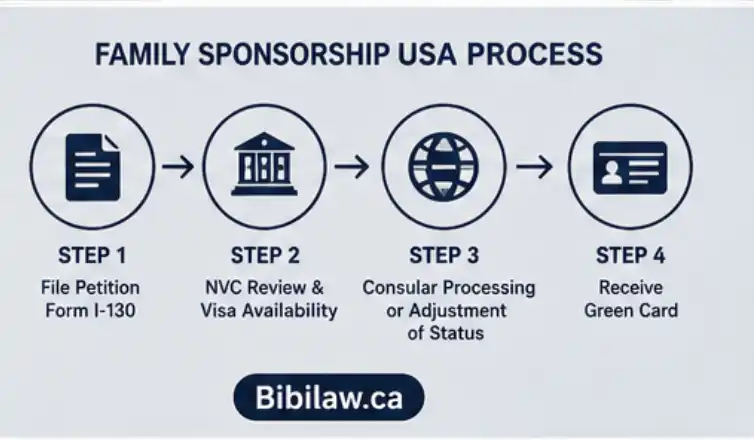
Step-by-Step: How the Family Sponsorship Process Actually Works
The family sponsorship process involves multiple government agencies, multiple forms, multiple fees, and a sequence of steps that must be completed in the right order. Here is how it unfolds.
Step One: Filing the Petition (Form I-130)
The process begins with the U.S. citizen or green card holder filing Form I-130, the Petition for Alien Relative, with U.S. Citizenship and Immigration Services (USCIS). This form establishes the qualifying relationship between the petitioner and the beneficiary. Supporting documents — proof of citizenship or permanent residence, proof of the relationship (marriage certificates, birth certificates, etc.) — must accompany the form along with the required fee.
USCIS will review the petition and either approve it, request additional evidence (a Request for Evidence, or RFE), or deny it. If approved, the case moves forward depending on whether the beneficiary is an immediate relative or falls under a preference category.
Step Two: The National Visa Center and Waiting
For immediate relatives, the wait between petition approval and the next step is relatively short. For preference category beneficiaries, this is where time stops. The approved petition is sent to the National Visa Center (NVC), which holds it until a visa number becomes available according to the USCIS Visa Bulletin — a monthly publication that tracks the progression of priority dates.
The priority date is essentially your beneficiary’s place in line — it is the date USCIS received the original I-130 petition. For immediate relatives, a visa number is always available. For preference categories, you wait until the Visa Bulletin shows that your priority date is current.
Step Three: Consular Processing or Adjustment of Status
Once a visa number is available, there are two possible pathways depending on where the beneficiary is located. If the beneficiary is outside the United States, the case proceeds through consular processing at a U.S. embassy or consulate abroad. The NVC will collect required documents, the beneficiary will attend an interview, and if approved, they will receive an immigrant visa to enter the United States as a lawful permanent resident.
If the beneficiary is already inside the United States and entered lawfully, they may be eligible to file for adjustment of status (Form I-485) to apply for a green card without having to leave the country. This process involves its own biometrics appointment, medical examination, and interview at a USCIS office.
Step Four: Receiving the Green Card
Upon successful completion of either consular processing or adjustment of status, the beneficiary becomes a lawful permanent resident of the United States, receiving their green card (Form I-551). This card, typically valid for 10 years (or 2 years for conditional residents married to U.S. citizens for less than 2 years), is the tangible proof of that permanent resident status and the right to live and work in the U.S. indefinitely.
Common Reasons Applications Get Denied or Delayed
Every year, thousands of family sponsorship applications run into problems — some fixable, some devastating. Knowing the most common pitfalls can save you months or years of waiting and thousands of dollars.
Incomplete or inconsistent documentation is one of the most frequent triggers for delays. If the name on your marriage certificate does not exactly match the name on your passport, USCIS will notice. If you fail to include certified translations of foreign-language documents, your case will stall. If your financial documents are incomplete or your income falls short of the threshold, your I-864 will be rejected.
Misrepresentation — even accidental — is another serious issue. If the information provided in the petition does not match what is submitted later in the process, it raises red flags. In the worst cases, a finding of fraud or willful misrepresentation can result in a lifetime bar from receiving a U.S. visa.
Prior immigration violations can also complicate or bar a sponsorship. If the beneficiary has ever overstayed a visa, entered the country without inspection, or been previously removed, there may be bars to receiving an immigrant visa that require waivers — additional applications with their own processes and timelines.
And then there is the public charge rule. USCIS assesses whether the beneficiary is likely to become primarily dependent on government benefits. The strength of the I-864, the beneficiary’s health and work history, and other factors all play into this determination.
Conditional Green Cards: When Your First Card Comes With a Two-Year Clock
If you are sponsoring a spouse and the marriage was less than two years old at the time the green card is granted, your spouse will receive a conditional green card — valid for only two years. Before that two-year window expires, the couple must jointly file Form I-751 to have the conditions removed and receive a permanent green card.
This requires demonstrating that the marriage is genuine and ongoing. Couples must submit evidence of a bona fide marriage: joint bank accounts, joint lease agreements, insurance policies, photographs, affidavits from people who know the couple, and more. If the marriage has ended — through divorce, separation, or the death of the sponsoring spouse — the beneficiary may still file for removal of conditions under special circumstances, but this is a more complex process.
Conditional green card situations are an area where legal guidance is especially valuable. The amount of supporting documentation required, the way it is assembled and presented, and the response to any USCIS inquiries can all meaningfully affect the outcome.
How Long Does Family Sponsorship Take?
This is the question everyone asks, and the answer is deeply unsatisfying: it depends. For immediate relatives, from the filing of the I-130 to receiving the green card, the process can take anywhere from roughly one year to two or more years, depending on USCIS processing times, NVC processing, consular scheduling, and the specific circumstances of the case.
For preference category beneficiaries, the question of the overall timeline is dominated by the visa backlog. Once you factor in the waiting time for a visa number to become current, total timelines for certain categories and certain countries of birth can stretch to a decade or longer. The F4 category — siblings of U.S. citizens from the Philippines, for example — has had wait times exceeding two decades for applicants from some countries.
The practical implication of this is profound. Families need to make long-term plans, manage expectations carefully, and avoid making major life decisions — selling a home, leaving a job, pulling children out of school — based on an assumed immigration timeline that may shift.
Why Legal Help Is Not Optional — It Is Essential
There is a common misconception that family sponsorship is a do-it-yourself process — that if you follow the instructions carefully enough, fill out the forms correctly, and submit the right documents, everything will work out fine. And for some straightforward cases, with no prior immigration issues, no complications, and complete documentation on both sides, that can be true.
But immigration law is not static. Forms change, USCIS policies evolve, processing times fluctuate, and the interpretation of eligibility rules can shift. An application that would have been straightforward five years ago may now trigger additional scrutiny. A sponsor who meets the income threshold on paper may still need to structure their evidence carefully to avoid an RFE. A beneficiary with a complicated travel history needs someone in their corner who has seen similar cases and knows how to address concerns proactively.
At bibilaw.ca, the approach is built on exactly this understanding. The firm works with families navigating the full spectrum of immigration complexity — from straightforward spouse sponsorships to multi-year preference category cases with prior complications. The goal is never just to fill out paperwork. It is to build a strategy around your specific circumstances, anticipate the questions before USCIS asks them, and position your case for the strongest possible outcome from the very beginning.
What Changes If the Sponsor Becomes a Citizen Mid-Process?
This is a situation that comes up more often than people expect, and it is actually one of the most significant positive developments that can happen during a pending sponsorship case. If a lawful permanent resident sponsors their spouse or unmarried child and then becomes a U.S. citizen while the case is pending, the beneficiary’s classification can be automatically converted, moving them from a preference category with waiting times to the immediate relative category with no numerical cap.
This is called “conversion” or “upgrading” a petition, and it can dramatically accelerate the timeline for the beneficiary. Notifying USCIS of the change in citizenship status is an important step in making sure this conversion is properly recorded and applied to the pending petition.
Maintaining Status During the Wait
One of the most stressful aspects of family sponsorship for beneficiaries who are already inside the United States is the question of maintaining lawful status while the case is pending. In most circumstances, filing Form I-485 (adjustment of status) keeps the beneficiary in a lawful period of authorized stay while the application is being adjudicated. This period is sometimes called “adjustment pending status” or “authorized stay.”
However, this is not universal. There are situations where a beneficiary may need to renew a separate visa, or where a gap in status could create complications. And traveling outside the United States while an adjustment of status application is pending — without an advance parole document — can result in the application being considered abandoned. These are the kinds of details that are easy to get wrong without experienced legal support.
Your Family Deserves More Than a Form
The United States family sponsorship system is, at its core, about something deeply human. It is about the mother who wants to grow old near her children. The spouse who has been waiting for years to finally share a home in the same city. The sibling who watched you build a life abroad and simply wants a chance to do the same. These are not abstractions. These are real people with real lives on hold.
The system that is supposed to facilitate those reunions is built on complex federal law, extensive documentation requirements, numerical caps, priority queues, financial thresholds, and an administrative apparatus that does not easily forgive mistakes. That gap — between the human reality and the bureaucratic complexity — is exactly where experienced immigration legal support makes the difference.
At bibilaw.ca, every case is approached with an understanding of what is actually at stake. Not just the forms. Not just the fees. The family is waiting on the other side.
If you are considering sponsoring a family member to come to the United States, do not wait until you are confused or something has gone wrong. Reach out early. Understand your options. Build your case correctly from the start. The sooner you begin with the right support, the closer your family gets to the reunion you have been waiting for.

Frequently Asked Questions About Family Sponsorship USA
Can a green card holder sponsor a sibling? No. Lawful permanent residents can only sponsor their spouses and unmarried children. Only U.S. citizens can sponsor siblings, and even then, siblings fall under the fourth preference category, which carries some of the longest wait times in the entire system.
Can I sponsor my parents if I am a U.S. citizen? Yes. Parents of U.S. citizens are immediate relatives, meaning there is no annual cap on visas, and the process generally moves faster than preference category cases. You must be at least 21 years old to sponsor a parent.
What if I cannot meet the income threshold for the Affidavit of Support? You can use a joint sponsor — a U.S. citizen or permanent resident who agrees to co-sign Form I-864 and whose income meets the required threshold. The joint sponsor takes on the same legal obligations as the primary sponsor.
Can the beneficiary work while waiting for the green card? If the beneficiary is inside the U.S. and has filed for adjustment of status, they can apply for an Employment Authorization Document (EAD) on Form I-765, which allows them to work legally while the application is pending. Beneficiaries outside the U.S. generally cannot work in the U.S. until they have received their immigrant visa and entered as a permanent resident.
What happens if my petition is denied? A denial can sometimes be appealed to the USCIS Administrative Appeals Office or the Board of Immigration Appeals, depending on the grounds of the denial. In other cases, a new petition may need to be filed. Legal guidance is critical when responding to or appealing a denial.
bibilaw.ca — Helping Families Navigate the Path Home