
Green Card Application USA: Why One Mistake Can Change Your Future
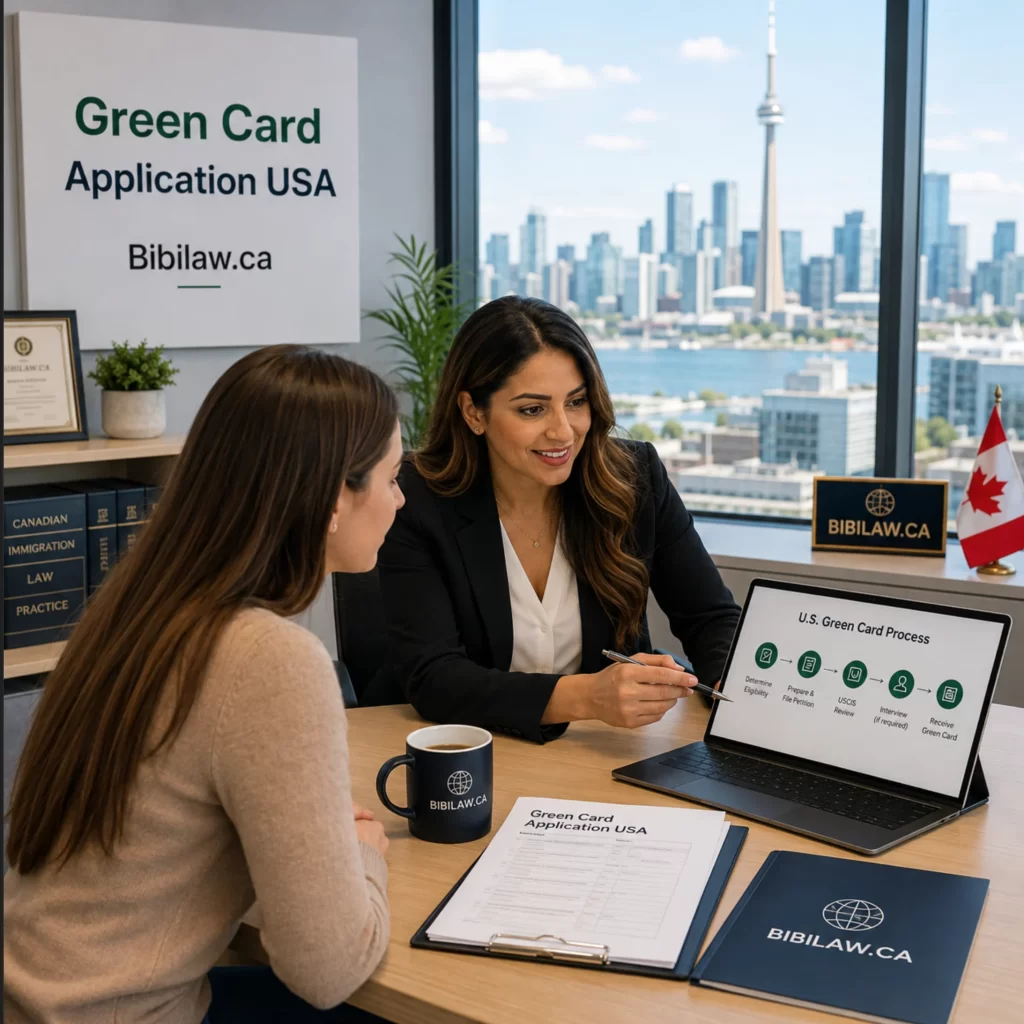
A Green Card Application USA is not just another immigration form. For many people living in Canada, working in Canada, studying in Canada, or planning a long-term move to the United States, it represents something much bigger: stability, family unity, career opportunity, lawful permanent residence, and the chance to build a future without constantly worrying about visa expiry dates. But the process is not simple. A missed document, wrong category, incorrect filing strategy, weak evidence, outdated medical form, inadmissibility issue, or misunderstanding of U.S. immigration rules can delay your case, trigger a request for evidence, or create serious problems that could have been avoided with the right legal guidance from the beginning.
At Bibi Law, we understand that immigration decisions are personal. A green card may affect where your family lives, where your children study, where you work, how you travel, and how secure your future feels. That is why applicants should not treat the Green Card Application USA process as a basic online checklist. Every case has a story, and every story needs the right legal route. Whether you are applying through family, employment, marriage, investment, humanitarian eligibility, or consular processing from outside the United States, the most important step is understanding which path fits your facts before you file anything.
What Is a Green Card in the USA?
A green card is proof that a person has lawful permanent resident status in the United States. A lawful permanent resident can generally live and work in the U.S. on a long-term basis, subject to the conditions and responsibilities attached to permanent residence. Many green card holders later become eligible to apply for U.S. citizenship if they meet the legal requirements, but a green card itself is not the same as citizenship. It is permanent residence, not a U.S. passport.
For applicants in Canada, the term “Green Card Application USA” can refer to different procedures depending on where the applicant is located and which immigration category applies. Some applicants may already be inside the United States and may apply through adjustment of status. Others may be in Canada and go through immigrant visa processing at a U.S. consulate after a petition is approved. The goal may be the same, but the steps, documents, risks, and timing can be very different.
This is where many people get confused. They search online, read about Form I-485, see videos about marriage green cards, hear about employment sponsorship, and assume all green card cases work the same way. They do not. A family-based applicant, an employment-based applicant, a person married to a U.S. citizen, a Canadian professional moving under employer sponsorship, a diversity visa selectee, and a refugee or asylee may all follow different legal paths. Choosing the wrong path can waste time and money.
Why Applicants in Canada Search for Green Card Application USA Help
Canada and the United States share a long border, deep business ties, family connections, and constant movement of professionals, students, entrepreneurs, and cross-border families. Many people living in Canada have close relatives in the U.S. Some work for companies with American operations. Some marry U.S. citizens. Some receive job offers from U.S. employers. Some want to reunite with children, parents, or spouses. Others see the U.S. as a long-term business or career destination.
Because Canada is so close to the United States, many applicants assume the process will be easier. In reality, U.S. immigration law applies the same seriousness to applicants from Canada as it does to applicants from anywhere else. Being in Canada may make travel and interview logistics easier in some cases, but it does not remove eligibility rules, documentation requirements, financial sponsorship obligations, medical exam requirements, admissibility screening, or visa availability issues.
Applicants in Canada also face unique planning questions. Should you remain in Canada while the immigrant visa process moves forward? Should you travel to the U.S. while a petition is pending? Could frequent U.S. visits create concerns about immigrant intent? Can your Canadian employment history support an employment-based case? Do you need police certificates or civil documents from more than one country? What happens if your spouse or children are included? These questions need careful review before filing.
Main Green Card Application USA Categories
The first step in any green card case is identifying the correct eligibility category. The U.S. immigration system does not offer one single green card form for everyone. Instead, an applicant usually qualifies through a specific legal basis. The most common categories include family-based green cards, employment-based green cards, marriage-based green cards, special immigrant categories, refugee or asylee-based green cards, diversity visa green cards, and certain humanitarian or special legal routes.
Family-based green cards are common when a U.S. citizen or lawful permanent resident sponsors a qualifying relative. Employment-based green cards may involve U.S. employer sponsorship, extraordinary ability, multinational manager or executive categories, advanced degree professionals, skilled workers, or investor-related options. Marriage-based green cards are often discussed separately because they involve both immigration eligibility and proof that the marriage is real and not entered into for immigration benefits.
For applicants in Canada, the right category often depends on the relationship, job offer, professional profile, immigration history, and long-term plan. A person with a U.S. citizen spouse may have a very different strategy from a Canadian engineer with a U.S. job offer. A business owner may need a different route from a parent being sponsored by a U.S. citizen child. A person who previously overstayed or had a visa refusal may need a risk review before taking the next step.
Family-Based Green Card Application USA
Family-based green card applications are built around a qualifying relationship with a U.S. citizen or lawful permanent resident. Immediate relatives of U.S. citizens may include spouses, unmarried children under 21, and parents of U.S. citizens who meet the age requirement to sponsor. Other family preference categories may include certain adult children and siblings of U.S. citizens, as well as spouses and unmarried children of lawful permanent residents.
The key issue in family-based cases is not simply proving that the relationship exists. The applicant must also follow the correct filing route, submit the correct forms, provide strong civil documents, meet financial sponsorship requirements, and avoid admissibility problems. In marriage-based cases, the government may review the bona fide nature of the marriage carefully. Evidence can include joint residence, shared finances, communication records, photos, travel history, affidavits, children’s birth certificates, insurance records, leases, tax documents, and other proof that the relationship is genuine.
For applicants in Canada, family-based processing may happen through consular processing if the applicant is outside the United States. If the applicant is already lawfully inside the U.S. and eligible, adjustment of status may be possible. The difference matters because the filing sequence, interview location, travel risks, and timing can change significantly.
Marriage Green Card: A High-Emotion, High-Evidence Case
A marriage green card can be one of the most meaningful immigration applications, but it can also be one of the most heavily reviewed. Immigration officers are trained to determine whether the marriage is legally valid and genuine. A real marriage does not always mean the evidence is automatically strong. Many genuine couples make mistakes because they assume love alone is enough. In immigration, documentation matters.
A strong marriage-based Green Card Application USA should tell a clear, consistent story. When did the couple meet? How did the relationship develop? When did they decide to marry? Do they live together? If they live apart, why? Do their families know about the relationship? Do they share financial responsibilities? Do they communicate regularly? Do their documents match the story? If the couple has cultural, religious, long-distance, age-gap, language, or previous-marriage factors, the application should be prepared with extra care so the evidence is organized and understandable.
Applicants in Canada may have cross-border relationships where one spouse lives in Canada and the other lives in the United States. These cases often require planning around visits, interviews, documents, and proof of ongoing relationship. A weak package can create delays, while a well-prepared package can make the officer’s review easier.
Employment-Based Green Card Application USA
Employment-based green card applications are designed for applicants who qualify through professional skills, employer sponsorship, investment, extraordinary ability, or other work-related categories. These cases can be powerful, but they are also document-heavy. Depending on the category, the process may involve a U.S. employer, labor certification, proof of qualifications, job duties, wage requirements, business records, recommendation letters, published work, awards, managerial experience, or evidence of national importance.
For Canadian professionals, an employment-based green card may be part of a larger cross-border career plan. Some applicants first work in the U.S. on a temporary work visa and later move toward permanent residence. Others may be sponsored directly from outside the United States. The right strategy depends on the employer, occupation, education, work history, timing, and visa availability.
Employment-based cases are not only about proving that a person is talented. The government wants to see that the legal category is properly matched to the evidence. A job title alone is not enough. The application should show why the applicant qualifies under the selected category and why the supporting documents satisfy the legal standard.
Adjustment of Status vs Consular Processing
One of the most important decisions in a Green Card Application USA is whether the applicant will apply through adjustment of status or consular processing. Adjustment of status generally applies when the applicant is already inside the United States and is eligible to apply for permanent residence without leaving the country. Consular processing generally applies when the applicant is outside the United States and completes immigrant visa processing through the Department of State and a U.S. embassy or consulate.
This difference is critical for applicants in Canada. If you are living in Toronto, Vancouver, Calgary, Montreal, Ottawa, Mississauga, Brampton, Edmonton, Winnipeg, or any other Canadian city, you may expect to process your immigrant visa through consular steps after petition approval. However, if you are already in the United States in lawful status and meet the rules, adjustment of status may be an option.
You should not choose between these routes based only on convenience. The decision can affect travel, work authorization, interview location, timing, costs, risk, and what happens if the case is denied. A person who leaves the United States at the wrong time may trigger problems. A person who enters the United States with the wrong intent may face serious questions. This is why legal strategy matters before filing.
Basic Green Card Application USA Process
Although every green card case is different, many cases follow a general pattern. First, the applicant identifies the correct eligibility category. Second, a petition is filed if required, such as a family petition or employment petition. Third, the applicant waits for petition approval and, in certain categories, visa availability. Fourth, the applicant either files adjustment of status or proceeds through consular processing. Fifth, the applicant completes biometrics, medical exam, document submission, financial sponsorship steps, interview preparation, and final review. Finally, if approved, the applicant receives permanent resident status.
This process sounds simple when reduced to steps, but the challenge is in the details. Which documents are required? Which forms apply? Is a visa number immediately available? Is the applicant admissible? Is the sponsor financially qualified? Are translations needed? Do civil documents meet the accepted format? Is the passport valid? Does prior immigration history create a risk? Has the applicant ever been refused, removed, overstayed, misrepresented information, worked without authorization, or had criminal issues? These details can change the entire strategy.
A successful green card application is not only complete. It is coherent. The forms, evidence, timeline, and legal theory should all match.
Documents Commonly Needed for a Green Card Application USA
The required documents depend on the category, but many green card applications involve identity documents, birth certificates, marriage certificates, divorce decrees, passport biographic pages, immigration status records, photographs, police certificates for consular cases, medical examination documents, financial sponsorship forms, tax records, employment letters, educational documents, and proof of relationship or job qualification.
Applicants in Canada should also consider whether any documents come from outside Canada. If you were born in another country, married in another country, divorced in another country, studied in another country, or lived in another country, the required civil documents may need to come from that jurisdiction. Some documents may require certified translation if they are not in English. Inconsistency between names, dates of birth, spellings, and addresses should be corrected or explained before submission.
One common mistake is uploading or mailing documents without checking whether they are the right version or whether the evidence is strong enough. Another mistake is assuming that because a document was accepted in Canada, it will automatically satisfy U.S. immigration expectations. U.S. immigration has its own rules and document standards.
Form I-485 and Adjustment of Status
For applicants applying from inside the United States, Form I-485 is the application to register permanent residence or adjust status. This is one of the central forms in many green card cases. It asks detailed questions about identity, immigration history, address history, employment history, family information, admissibility, security, prior violations, and eligibility.
Form I-485 should never be treated casually. The answers can affect the case deeply. If an applicant misunderstands a question, gives incomplete information, forgets prior immigration events, or answers inconsistently with earlier visa forms, the case can become more complicated. Even innocent mistakes may lead to delays or requests for clarification.
Applicants should review their full immigration history before filing. This includes prior U.S. visa applications, border entries, refusals, overstays, employment, school attendance, changes of status, arrests, citations, removal orders, or previous petitions. If there is any concern, it should be reviewed before the application is submitted, not after the government asks about it.
Medical Examination and Vaccination Requirements
Many green card applicants must complete an immigration medical examination using the required U.S. immigration medical process. For adjustment of status cases, the medical exam is documented on the proper USCIS medical form completed by a designated civil surgeon. For consular processing, applicants usually follow medical exam instructions from the U.S. embassy or consulate and attend an exam with an approved panel physician.
The medical exam is not a normal family doctor checkup. It is an immigration-specific requirement. Applicants should follow the official instructions carefully, use the correct doctor category, bring vaccination records, and avoid opening sealed envelopes if the process requires sealed submission. Missing or outdated medical documentation can delay a green card decision.
For applicants in Canada, the medical process may differ depending on whether they are adjusting status in the U.S. or completing consular processing from Canada. This is another reason to confirm the correct procedure before booking appointments or submitting forms.
Financial Sponsorship and Public Charge Concerns
Many family-based green card applications require a financial sponsor to submit an affidavit of support. The purpose is to show that the intending immigrant has adequate financial support and is not likely to become dependent in a way that creates immigration concerns. Sponsors may need to provide tax records, income evidence, employment letters, and proof of U.S. status. In some cases, a joint sponsor may be needed.
Financial sponsorship can be a sensitive issue. A sponsor may love the applicant but not meet the income requirement. A sponsor may be self-employed and have tax documents that do not clearly show qualifying income. A sponsor may live abroad or have recently moved. A sponsor may have dependents that affect household size. These details must be reviewed carefully.
Employment-based and other categories may involve different financial or economic evidence. The main point is the same: U.S. immigration officers expect credible documentation, not vague promises.
Common Green Card Application USA Mistakes
Many applicants damage their own cases before they ever speak with a lawyer. They choose the wrong category because a friend had a similar case. They file forms too early or too late. They submit weak evidence. They forget prior addresses or employment. They provide inconsistent dates. They do not disclose a previous refusal. They travel without understanding the consequences. They assume a pending petition gives them permission to live or work in the United States. They ignore requests for evidence until the deadline is close. They rely on online forums instead of legal advice.
Another common mistake is treating the green card process as only a form-filling exercise. Immigration forms are important, but they are not the whole case. The legal eligibility, supporting evidence, timing, admissibility review, and strategy matter just as much. A beautifully completed form cannot fix an applicant who is not eligible. A strong applicant can still face problems if the evidence is disorganized or incomplete.
At Bibi Law, the goal is to help applicants understand the process clearly before they make decisions that may be difficult to reverse.
Red Flags That Need Legal Review Before Filing
Some cases should receive legal review before any application is submitted. Red flags may include prior U.S. visa refusals, overstays, unauthorized work, misrepresentation concerns, criminal charges or convictions, previous removal or deportation orders, unlawful presence, use of false documents, inconsistent marital history, previous immigration petitions, prior asylum claims, medical inadmissibility issues, financial sponsorship weakness, or complicated custody issues involving children.
A red flag does not always mean the case is impossible. It means the case should be handled carefully. Some issues may require waivers. Some may require detailed legal explanations. Some may require waiting, correcting records, gathering additional evidence, or choosing a different route. The worst approach is to hide the issue or hope the officer will not notice. Immigration systems often connect prior records, and inconsistent answers can create bigger problems than the original issue.
If you are unsure whether something matters, assume it might and ask before filing.
Green Card Interview Preparation
Many green card applicants must attend an interview. The interview may focus on identity, eligibility, relationship, employment, immigration history, documents, admissibility, and the truthfulness of the application. Marriage-based interviews may include detailed questions about the relationship, daily life, shared responsibilities, family knowledge, and future plans.
Good interview preparation does not mean memorizing fake answers. It means knowing your own case, understanding what was filed, bringing organized documents, answering honestly, and being ready to explain any confusing facts. Applicants should review copies of all submitted forms and evidence before the interview. If a lawyer is involved, the lawyer can help identify likely issues and prepare the applicant for the structure of the interview.
For applicants processing from Canada, consular interviews may require careful preparation of original civil documents, police certificates, financial evidence, medical exam completion, and passport readiness. Each consulate may have specific instructions, so applicants should not rely only on general information.
How Long Does a Green Card Application USA Take?
There is no single timeline for every Green Card Application USA. Processing time depends on the category, petition type, visa availability, government workload, background checks, completeness of documentation, interview scheduling, requests for evidence, consular appointment availability, and whether any legal issues arise. Immediate relative cases may move differently from family preference cases. Employment cases may move differently from diversity or humanitarian cases. Adjustment of status timelines may differ from consular processing timelines.
Applicants should be cautious with anyone who guarantees a timeline. Immigration processing can change. A well-prepared case can reduce avoidable delays, but it cannot control every government timeline. The better question is not only “How long will it take?” but also “What can we do now to avoid unnecessary delays?”
That means filing the correct forms, using the correct edition, submitting strong evidence, responding quickly to government notices, keeping addresses updated, attending biometrics and interviews, and avoiding travel or status mistakes while the case is pending.
Can You Visit the USA While a Green Card Case Is Pending?
This is one of the most common questions for applicants in Canada. The answer depends on the person’s immigration status, travel history, pending application type, intent, and whether the person is seeking entry temporarily or trying to live in the United States before approval. A pending immigrant petition can raise questions at the border because it may show immigrant intent. That does not automatically mean every visit is impossible, but it does mean travel should be approached carefully.
Applicants should be honest at the border and should never misrepresent their purpose of travel. If you are visiting temporarily, your documents and answers should support temporary travel. If you are planning to move permanently, you generally need the proper immigrant visa or adjustment approval process. Misrepresentation at the border can create serious immigration consequences.
Before traveling during a green card process, applicants should seek legal advice based on their specific facts.
Green Card for Canadians: Is There a Special Shortcut?
Many Canadians hope there is a special green card shortcut because Canada and the United States have a close relationship. While Canadians may benefit from certain temporary work visa options in some circumstances, a green card is still governed by U.S. permanent residence law. Canadian citizenship alone does not automatically create green card eligibility.
A Canadian applicant still needs a qualifying family relationship, employment category, investment route, diversity visa selection, humanitarian basis, or another recognized legal path. The applicant must still meet admissibility requirements, provide documents, complete medical steps, and follow the correct procedure.
The advantage for applicants in Canada is often practical rather than automatic. They may have easier access to documents, cross-border employers, U.S. family, or consular processing logistics. But the legal burden remains real.
Why Choose Bibi Law for Green Card Application USA Guidance?
A green card case can shape your future, and the process deserves serious legal attention. Bibi Law helps applicants understand their options, identify risks, prepare stronger applications, and avoid common mistakes. For individuals and families in Canada who are exploring U.S. permanent residence, proper guidance can make the process clearer, more organized, and less stressful.
The value of legal support is not only in completing forms. It is in asking the right questions before the forms are completed. Are you eligible? Is this the best category? Should you apply now or wait? Are there inadmissibility concerns? Is your relationship evidence strong enough? Does your employment evidence satisfy the category? Are your documents consistent? Is consular processing safer than adjustment of status? What should you do if you receive a request for evidence?
At bibilaw.ca, the focus is on helping clients make informed decisions. Immigration is too important for guesswork.
Step-by-Step Green Card Application USA Checklist
Before starting your Green Card Application USA, review your eligibility category carefully. Confirm whether you are applying through family, marriage, employment, investment, diversity visa, humanitarian status, or another route. Next, gather identity and civil documents, including birth certificates, marriage certificates, divorce records, passports, immigration records, and prior visa documents. If your documents are not in English, arrange proper translations.
Then review your immigration history. List every prior U.S. visa application, entry, exit, refusal, overstay, petition, school status, work authorization, and immigration notice. If you have ever had a criminal charge, even if dismissed, get legal advice before filing. If you are applying through a sponsor, confirm the sponsor’s status, income, tax documents, and household size. If you are applying through employment, confirm the job offer, employer support, qualifications, and category requirements.
Finally, prepare the application package with consistency. Names, dates, addresses, and facts should match across forms and documents. Keep copies of everything submitted. Track deadlines. Respond to notices on time. Prepare for biometrics and interview. Do not make major travel or employment decisions without understanding how they may affect your case.
The Human Side of a Green Card Application
Behind every green card file is a human story. A spouse waiting to live with their partner. A parent wanting to be close to their child. A professional accepting a life-changing opportunity. A family choosing where their future will begin. A business owner expanding into a new market. A student building a career. A person who wants certainty after years of temporary status.
That is why the Green Card Application USA process should not feel cold, confusing, or careless. Yes, the law matters. Yes, the forms matter. Yes, the evidence matters. But the story matters too. A strong application connects the legal requirements with the real facts of the applicant’s life.
When the case is prepared properly, the officer should be able to understand who you are, why you qualify, and how the evidence supports your eligibility. That level of clarity does not happen by accident. It comes from preparation.
Frequently Asked Questions About Green Card Application USA
1. What is a Green Card Application USA?
A Green Card Application USA is the process of applying for lawful permanent residence in the United States. The process may be based on family, marriage, employment, investment, humanitarian eligibility, diversity visa selection, or another recognized category. The correct steps depend on the applicant’s location, eligibility, and immigration history.
2. Can I apply for a U.S. green card from Canada?
Yes, many applicants living in Canada may apply for a U.S. green card through consular processing if they qualify under a valid category. Some applicants who are already lawfully inside the United States may qualify for adjustment of status, but this depends on their facts.
3. Do Canadians automatically qualify for a U.S. green card?
No. Canadian citizenship does not automatically qualify a person for a U.S. green card. Canadians must qualify through a valid U.S. immigration category, such as family sponsorship, employment sponsorship, marriage to a U.S. citizen, investment, or another eligible route.
4. What is the difference between adjustment of status and consular processing?
Adjustment of status is generally for eligible applicants already inside the United States who apply for permanent residence without leaving the country. Consular processing is generally for applicants outside the United States who complete immigrant visa processing through the Department of State and a U.S. consulate.
5. What documents are needed for a Green Card Application USA?
Common documents may include passport copies, birth certificates, marriage certificates, divorce records, immigration records, photographs, medical exam documents, financial sponsorship records, employment evidence, police certificates for some consular cases, and translations where required. The exact list depends on the category.
6. How long does a Green Card Application USA take?
Processing time depends on the category, visa availability, government workload, completeness of the application, interview scheduling, background checks, and whether the government requests more evidence. No lawyer can honestly guarantee an exact timeline for every case.
7. Can I work in the USA while my green card is pending?
You may only work in the United States if you have proper authorization. A pending green card case alone does not always give immediate work authorization. Some adjustment of status applicants may apply for employment authorization, but eligibility depends on the case.
8. Can I travel while my green card application is pending?
Travel depends on your immigration status, application type, and whether travel could affect your pending case. Applicants should get legal advice before traveling, especially if they have a pending adjustment of status application or any prior immigration issues.
9. What happens if my green card application is refused?
The consequences depend on why the case was refused and which process was used. Some cases may be corrected, appealed, reopened, refiled, or reviewed for waivers. A refusal should be assessed carefully before taking the next step.
10. Why should I get legal help for a Green Card Application USA?
Legal guidance helps identify the right category, prepare stronger evidence, avoid filing mistakes, review inadmissibility risks, respond to government notices, and create a strategy based on your specific facts. A green card case is too important to handle through guesswork.
Start Correctly Before You File
If you are in Canada and thinking about a Green Card Application USA, do not wait until a mistake happens to seek guidance. The best time to review your case is before filing, before traveling, before submitting incomplete evidence, before answering difficult questions incorrectly, and before deadlines begin.
A green card can open the door to long-term life in the United States, but the process must be handled with care. Whether your case is family-based, marriage-based, employment-based, or consular, the right strategy can protect your time, your money, and your future.
For guidance on your Green Card Application USA, visit bibilaw.ca and speak with a legal professional who can help you understand your options from Canada.